
Ruth Murray Underhill (August 22, 1883 – August 15, 1984) was a pioneering American anthropologist renowned for her extensive work with Native American tribes, particularly the Tohono O’odham (formerly known as the Papago) and Pueblo peoples. Born into a Quaker family in Ossining-on-the-Hudson, New York, she was the eldest of four children. Her early education at the Ossining School for Girls and later at Vassar College, where she graduated in 1905 with honors in English and Comparative Literature, laid a strong foundation for her future endeavors. Her upbringing instilled in her values of pacifism, hard work, and the importance of education Her life’s work can be viewed through four key lenses: Anthropologist, Humanitarian, Educator, and Writer.
Ruth Murray Underhill (1883–1984)
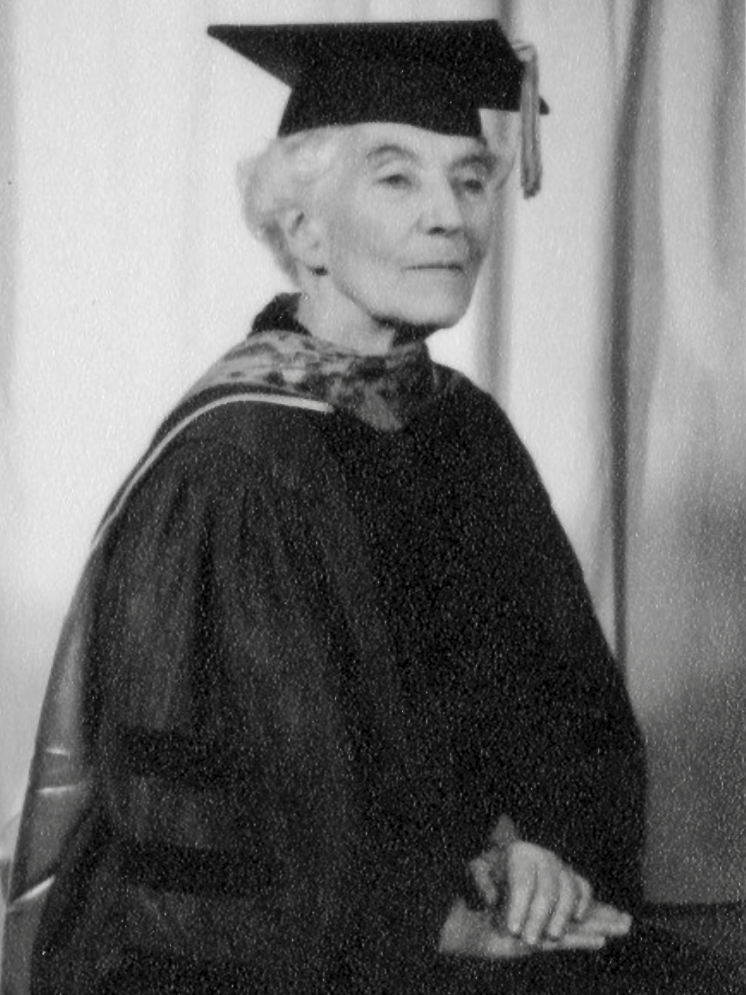
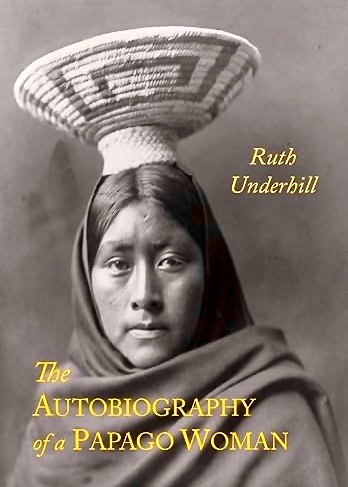
After her initial studies, Underhill engaged in various roles, including teaching Latin and working as a social worker with the Massachusetts Society for the Prevention of Cruelty to Children. During World War I, she served with the American Red Cross in Italy, establishing orphanages and investigating child labor for the Rockefeller Foundation. Following her divorce in 1929, she sought a deeper understanding of human behavior, leading her to Columbia University. There, under the mentorship of Franz Boas and Ruth Benedict, she pursued anthropology, earning her Ph.D. in 1937.
Boasian Influence
Underhill’s entry into anthropology came after a personal and professional turning point—her divorce in 1929. Seeking deeper insight into human behavior and cultural differences, she enrolled at Columbia University, where she studied under Franz Boas, the founder of American cultural anthropology, and Ruth Benedict, one of Boas’s most prominent protégés. Boas’s emphasis on cultural relativism and meticulous fieldwork left a profound imprint on Underhill. She adopted his insistence on documenting Indigenous cultures with empathy and accuracy, while rejecting racial hierarchies. Benedict’s influence, particularly in examining patterns of culture and personality, is also evident in Underhill’s attention to individual life stories, especially among Native women. This Boasian foundation shaped not only Underhill’s methods but also her lifelong commitment to preserving and honoring Native American voices.
Anthropology
Underhill’s anthropological legacy is most closely associated with her fieldwork among the Tohono O’odham (formerly known as the Papago) in southern Arizona. Immersing herself in their daily lives over several summers, she focused particularly on women’s experiences and social roles. Her Ph.D. dissertation at Columbia, completed in 1937 under Boas’s direction, led to her groundbreaking publication Autobiography of a Papago Woman (1936). This work, one of the earliest ethnographies centered on a Native American woman’s voice, broke ground in both feminist and Indigenous studies. Underhill also worked with various Pueblo communities, carefully documenting their ceremonial life, agricultural practices, kinship systems, and oral traditions. Her work exemplified the Boasian commitment to cultural relativism and helped build a more nuanced public understanding of Native societies in the American Southwest.
Humanitarian
Born into a Quaker family in Ossining-on-the-Hudson, New York, Underhill was raised with a commitment to peace, service, and education. After graduating from Vassar College in 1905 with honors in English and Comparative Literature, she pursued social work and later joined the American Red Cross during World War I. Stationed in Italy, she organized orphanages, coordinated relief efforts, and worked on investigations into child labor for the Rockefeller Foundation. These early humanitarian efforts foreshadowed her later work in Indian education, where she advocated for more culturally grounded and respectful approaches. Her efforts were not driven solely by academic curiosity but by a belief in cultural dignity and social justice, particularly for Indigenous peoples facing the pressures of assimilationist policy.
Educator
Underhill’s work as an educator was multifaceted. From 1934 onward, she worked for the U.S. Bureau of Indian Affairs (BIA), where she rose to become Supervisor of Indian Education—the first woman to hold that position. She was instrumental in revising curricula to include Native perspectives, traditions, and languages, a radical shift at a time when federal policy essentially sought to erase Indigenous identities through education. During World War II, she also helped train government staff working in Japanese-American internment camps, promoting cultural understanding. After retiring from government service, Underhill taught anthropology at the University of Denver (1948–1952), where she brought her rich field experience and progressive values into the classroom. Her dedication to education persisted well into her later years, as she lectured and wrote into her nineties.
Writer
Ruth Underhill was a gifted and prolific writer who translated anthropological knowledge into accessible, compelling prose. Her bibliography includes more than a dozen books and numerous articles. Beyond Autobiography of a Papago Woman, she authored Red Man’s America (1944), a widely used textbook; First Penthouse Dwellers of America (1936), an introduction to cliff-dwelling peoples; and several children’s books on Native American themes. Her writing was notable for its empathy, clarity, and deep respect for her subjects. She brought Indigenous cultures to a broad audience during a time when mainstream narratives often distorted or erased Native voices. Her ability to communicate across scholarly and public domains helped shape mid-century understandings of Native American life.
Legacy
In 1979, the Tohono O’odham Nation formally honored Ruth Underhill for her work preserving their cultural history. She lived to the age of 100, bridging the formative years of American anthropology and the post-war shifts toward inclusion, ethics, and cultural preservation. Her career—spanning continents, crises, and cultures—embodied the spirit of socially engaged anthropology. Through her lens as an Anthropologist, Humanitarian, Educator, and Writer, Ruth Underhill leaves behind a legacy as one of the most quietly influential figures in 20th-century American anthropology.
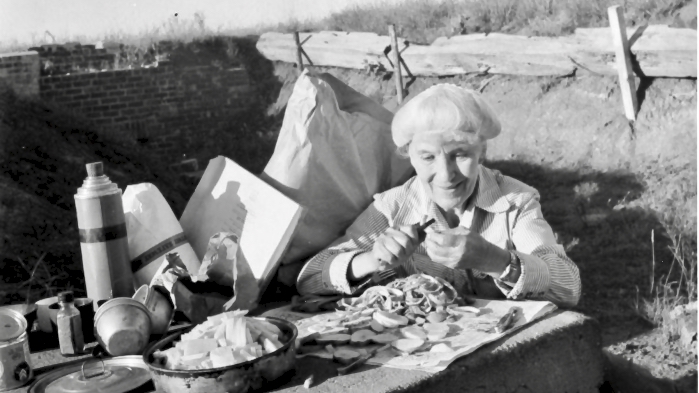
Dr. Underhill peeling potatoes at her campsite in Arizona, c. 1936
Courtesy of the Denver Museum of Nature & Science
References & Resources
Ossining History on the Run. (2025, February 23). Dr. Ruth Murray Underhill, anthropologist. https://ossininghistoryontherun.com/2025/02/23/dr-ruth-murray-underhill-anthropologist/
Smithsonian Institution Archives. (n.d.). Ruth Murray Underhill papers. Retrieved from https://siarchives.si.edu
Underhill, R. M. (1936). Autobiography of a Papago woman. U.S. Government Printing Office.
Underhill, R. M. (1936). First penthouse dwellers of America. J. J. Augustin.
Underhill, R. M. (1944). Red man’s America: A history of Indians in the United States. University of Chicago Press.
Wikipedia contributors. (n.d.). Ruth Murray Underhill. In Wikipedia, The Free Encyclopedia. Retrieved December 20, 2025, from https://en.wikipedia.org/wiki/Ruth_Murray_Underhill
Images
Amazon.com. (n.d.). Autobiography of a Papago woman [Book cover image]. Retrieved December 19, 2025, from https://www.amazon.com/Autobiography-Papago-Woman-Ruth-Underhill/dp/1614278997
Denver Museum of Nature & Science. (c. 1950). Dr. Ruth Underhill in cap and gown for a University of Denver Commencement [Photograph]. Courtesy of the Denver Museum of Nature & Science.
Parsons, E. W. C. (1918–1926). Adobe dwelling with ladder [Photograph of Tewa settlement, Tesuque Pueblo, New Mexico]. Elsie Clews Parsons Papers. American Philosophical Society. Retrieved from https://diglib.amphilsoc.org/islandora/object/graphics%3AMss.Ms.Coll.29?f%5B0%5D=collection_block%3AElsie%20Clews%20Parsons%20Papers
Acknowledgements
Researched and written with the assistance of ChatGPT-4 by OpenAI (https://chat.openai.com)
Please Consider A Contribution To Help Maintain This Site!
Make a one-time donation
Make a monthly donation
Make a yearly donation
Choose an amount
Or enter a custom amount
Your contribution is greatly appreciated.
Your contribution is appreciated.
Your contribution is appreciated.
`
